Tuesday, September 18, 2012

Trademark Infringement Claims By Catholic Order Against Florida Priory


THIS published opinion released by the Eleventh Circuit last week had a Da Vinci Code feel to it. 
The Plaintiff/Appellant was a religious order of the Roman Catholic Church. The Defendant/Appellee was "The Florida Priory of the Knights Hospitallers of the Sovereign Order of Saint John of Jerusalem, Knights of Malta, The Ecumenical Order (The Florida Priory) is also a charitable organization, having an expressly ecumenical, rather than Catholic, association." The two organizations have similar roots that the opinion discusses in some detail. The dispute related to allegedly confusingly similar marks used by both organizations. 
The district court cancelled four of the Plaintiff's marks for fraud on the Patent and Trademark Office. The district court found the only remaining service mark visually dismissal to the defendants mark and rejected the Lanham Act claims for that remaining mark. Finding no likelihood of confusion, the district court also denied the Plaintiff's state law claims. 
Fraud on the PTO
The Eleventh Circuit noted that "The district court explained that Pace was personally unaware of the existence of The Ecumenical Order at the time he signed the applications and the accompanying oath." The Eleventh Circuit discussed its prior law on the issue and held that "Pace had no awareness that any other organization was using the marks for which Plaintiff Order sought federal protection.  This fact alone compels reversal of the fraud finding, as Pace could not have intended to deceive the PTO in attesting to an oath that he believed was entirely accurate." 
The Eleventh Circuit also rejected the District Court's basis to support its finding of fraud. "To support its finding of fraud, the district court analogized to the Supreme Court’s recent decision in Global-Tech Appliances, Inc. v. SEB S.A., 563 U.S. ___, 131 S. Ct. 2060 (2011).  Global-Tech considered whether knowledge of infringement was required to sustain a claim that a party actively induced infringement of a patent under 35 U.S.C. § 271(b).  Id. at 2063." …. "It was error to look to this case for the applicable standard to analyze a claim for fraud on the PTO.  We have been admonished to exercise caution before importing standards from one area of intellectual-property law into another….The Florida Priory has not pointed to any authority to establish the sort of 'historic kinship' that may justify translation of a patent-infringement standard into the mark-application context."
For its final note on the fraud claim, the Eleventh Circuit stated "[t]here is one additional aspect of the fraud analysis that the district court did not address. If the declarant subjectively believes the applicant has a superior right to use the mark, there is no fraud, even if the declarant was mistaken."
Lanham Act Infringement Claim
"The Lanham Act prohibits the unauthorized use of a mark in commerce that is confusingly similar to a registered service mark. 15 U.S.C. § 1114(1)(a). To prevail on a civil infringement claim brought under 15 U.S.C. § 1125, a plaintiff must establish that (1) its mark is entitled to protection and (2) the defendant 'adopted an identical or similar mark such that consumers were likely to confuse the two.' Int’l Stamp Art, Inc. v. United States Postal Serv., 456 F.3d 1270, 1274 (11th Cir. 2006) (per curiam)."  
After describing the test it applies, the court held: "Here, because the district court did not make any additional factual findings to aid us in evaluating whether it committed clear error, we have an “insufficient basis” to evaluate its ultimate conclusion.  Id. As a result, we remand the infringement claim so the district court may conduct the proper, multi-factor infringement analysis for the design marks. The district court should also conduct this analysis for Plaintiff Order’s word marks, which were improperly canceled for fraud."
Lanham Act False Advertising Claim
"Under the Lanham Act, an entity that misrepresents the 'nature, characteristics, qualities, or geographic origin' of its services in commercial advertising or promotion is liable to the persons damaged by the false or misleading representation. 15 U.S.C. § 1125(a)(1)." ... "The district court essentially agreed with the version of history as presented by The Florida Priory and, specifically, by Papanicolaou.  On appeal, Plaintiff Order argues that its witnesses, rather than those of The Florida Priory, accurately recited the relevant history.  It attributes error to the district court’s reliance on the testimony of Papanicolaou—who did not hold himself out to be an expert in history—over the testimonies of Gamble and Dr. Vann—only one of whom was qualified as an expert in the history of the Order of Malta.  We conclude that the district court did not clearly err in its factual findings and therefore affirm its disposition of the false advertising claim."
State Law Claims
​"The success of Plaintiff Order’s state unfair competition and FDUTPA claims is tied to the federal Lanham Act claims for infringement and false advertising.  See Natural Answers, Inc. v. Smithkline Beecham Corp., 529 F.3d 1325, 1333 (11th Cir. 2008).  Because we vacate the ruling on the infringement claim as related to the design mark and remand for reconsideration utilizing the multifactor test, we likewise vacate the district court’s conclusions with regard to the analogous state claims.  
Next, because we reverse the district court’s cancellation of the registered word marks, we also vacate the portion of the district court’s order disposing of the state claims based on these word marks so it has the opportunity to revisit them based on a complete analysis under the correct standard."

Petition for Writ of Mandamus To Obtain Purported Public Records Denied


In Harvard v. City of Palm Springs, the Fourth District affirmed the Circuit Court's denial of a petition for writ of mandamus. The mother of a minor involved in an altercation sought the police report and video interview of the other minor. The city agreed it could provide the information, however, argued that the decision to provide the material was discretionary. The court stated:
The Village concedes that Harvard, as the representative of her son, qualifies as a "victim." However, the Village emphasizes that although section 985.04(3) permits the release of a juvenile offense report to a victim, such a release is discretionary, not mandatory. In support of its argument, the Village emphasizes the presence of the word "may" in the statute.
First, we address whether the Village was required to produce the requested juvenile offense report to Harvard under section 985.04(3). Our analysis begins by applying accepted rules of statutory construction. "Legislative intent is the polestar that guides a court?s statutory construction analysis." Bautista v. State, 863 So. 2d 1180, 1185 (Fla. 2003). In attempting to discern legislative intent, we first look to the actual language used in the statute. Joshua v. City of Gainesville, 768 So. 2d 432, 435 (Fla. 2000). If the statute is clear and unambiguous, we will not look behind its plain language for legislative intent or resort to rules of statutory construction to ascertain intent. See Lee County Elec. Coop., Inc. v. Jacobs, 820 So. 2d 297, 303 (Fla. 2002). In such an instance, “the statute’s plain and ordinary meaning must control, unless this leads to an unreasonable result or a result clearly contrary to legislative intent.” State v. Burris, 875 So. 2d 408, 410 (Fla. 2004). Here, the issue is whether the term “may” as used in section 985.04(3) is permissive or mandatory. We hold that the plain language of section 985.04(3) is unambiguous, and thus interpret the word “may” as a permissive term. Noel v. Sheldon J. Schlesinger, P.A., 984 So. 2d 1265, 1267 (Fla. 4th DCA 2008) (“The word ‘may’ denotes a permissive term rather than the mandatory connotation of the word ‘shall.’”) (citations and quotations omitted). Accordingly, we affirm the trial court’s ruling that the Village was not required to produce the requested juvenile offense report to Harvard.
The court also rejected the mother's attempt to obtain a copy of the video interview of her son. The public records request fell into an exemption.

Post Loss Insurance Claim Can Be Assigned, But The Insured Still Must Cooperate With Loss Investigation


​In Citizens Property Insurance Corporation v. Ifergane (3D10-1195 & 3D09-3293), the Third District affirmed the trial court in part and reversed in part. Because post-loss insurance claims are freely assignable in Florida, the trial court correctly dismissed the former spouse who had assigned her interest in the claim. However, that did not relieve the former spouse of her obligations to cooperate pursuant to the contract (insurance policy). The court stated:
Because we find there were genuine issues of material fact as to whether Haim was a resident spouse on the date of loss, and because the Assignment did not relieve Alexandra of her post-loss obligations as a named insured under the policy, we reverse.

Friday, August 31, 2012

Unsigned Opinion From Divided Federal Circuit

The Federal Circuit released an en banc opinion today in Akamai Technologies v. Limelight Networks. The decision was an unsigned per curiam opinion joined by six members of the court. The other five members of the court dissented. The unsigned, divided, en banc opinion is what caught my attention (those facts, not the contents of the opinion). That aside, the majority stated:
In the two cases before us, we address the question whether a defendantmay be held liable for induced infringement if the defendant has performed some of the steps of a claimed method and has induced other parties to commit the remainingsteps (as in the Akamai case), or if the defendant hasinduced other parties to collectively perform all the stepsof the claimed method, but no single party has performedall of the steps itself (as in the McKesson case).

***
Much of the briefing in these cases has been directedto the question whether direct infringement can be foundwhen no single entity performs all of the claimed steps ofthe patent. It is not necessary for us to resolve that issuetoday because we find that these cases and cases likethem can be resolved through an application of the doc-trine of induced infringement. In doing so, we reconsiderand overrule the 2007 decision of this court in which weheld that in order for a party to be liable for inducedinfringement, some other single entity must be liable fordirect infringement. BMC Resources, Inc. v. Paymentech,L.P., 498 F.3d 1373 (Fed. Cir. 2007). To be clear, we holdthat all the steps of a claimed method must be performedin order to find induced infringement, but that it is notnecessary to prove that all the steps were committed by asingle entity.

Foreclosure Judgment Reversed With Instructions To Enter Judgment In Favor Of Defendant Due To Lack of Prosecution

In Spencer v. EMC Mortgage Corp. (3D11-0136), the Third District reversed a judgment with instructions to enter judgment against the Plaintiff/Appellee for lack of prosecution. In July 1997, Spencer stopped making payments on her mortgage. In 2002, a foreclosure complaint was filed that, after a number of motions were filed, "the case languished for thirteen months. The trial court issued a notice of lack of prosecution (order to show cause why the case should not be dismissed), docketed on March 5, 2009, and it scheduled a hearing for the matter for May 29, 2009. There was no record activity in the case during the sixty-day period following the notice of lack of prosecution." Nothing was filed until three days before the hearing, when an unsworn document was filed that "advised the court that the order to show cause had been sent to the offices of prior counsel—not EMC’s successor counsel—and that he had only learned of the notice two weeks earlier by checking the docket." 

The Third DCA noted that "EMC’s brief is more candid. EMC’s counsel actually became aware of the notice of lack of prosecution (docketed March 5, 2009) in “late March or April, during a review of the lower court docket.” EMC’s attorney’s fee affidavit and billing records are even more definitive: a March 30, 2009, time entry narrative states “Review and analyze docket re order entered to show cause why case should not be dismissed for lack of prosecution.” EMC thus had ample time, over a month, within the sixty-day window allowed for record activity that would defeat dismissal. That fact, without more, takes this case out of the 'no notice received' exceptions detailed in Deutsche Bank National Trust Co. v. Basanta, 88 So. 3d 216 (Fla. 3d DCA 2011), and Boosinger v. Davis, 46 So. 3d 152, 154 n.2 (Fla. 2d DCA 2010)."

The court also determined further prosecution would be barred by the statute of limitations. In conclusion, the court stated:

The final summary judgment is reversed. The order denying the motion to dismiss for failure to prosecute the second, 2002 foreclosure case is reversed and vacated. The case is remanded to the trial court for dismissal and for an award of trial and appellate attorney’s fees and costs to Ms. Spencer.

As a footnote the conclusion quoted above, the Third District addressed an interesting issue regarding the availability of fees. The court stated: "In view of the likelihood that this action is barred by the applicable statute of limitations, a party may question whether any motion for attorney’s fees and costs may now be pursued. We conclude that such a motion may proceed based on the analysis in Katz v. Van Der Noord, 546 So. 2d 1047, 1049 (Fla. 1989) (holding that attorney’s fees may be recovered under a prevailing party provision even though the contract itself is determined to be unenforceable)."

In a special concurrence, Judge Schwartz began:

Because of the stumbling, bumbling, and general ineptitude of the mortgagee and its representatives, the appellant has managed to remain in the mortgaged premises without payment for over fifteen years after defaulting in 1997. While it therefore pains me deeply to do so, I concur in the reversal of the summary judgment of foreclosure against her. I do so for two reasons.

His entire special occurrence begins on page 10 of the opinion.

Sunday, July 22, 2012

Mandatory E-Mail Service In All Florida Civil Cases & eserve.cc

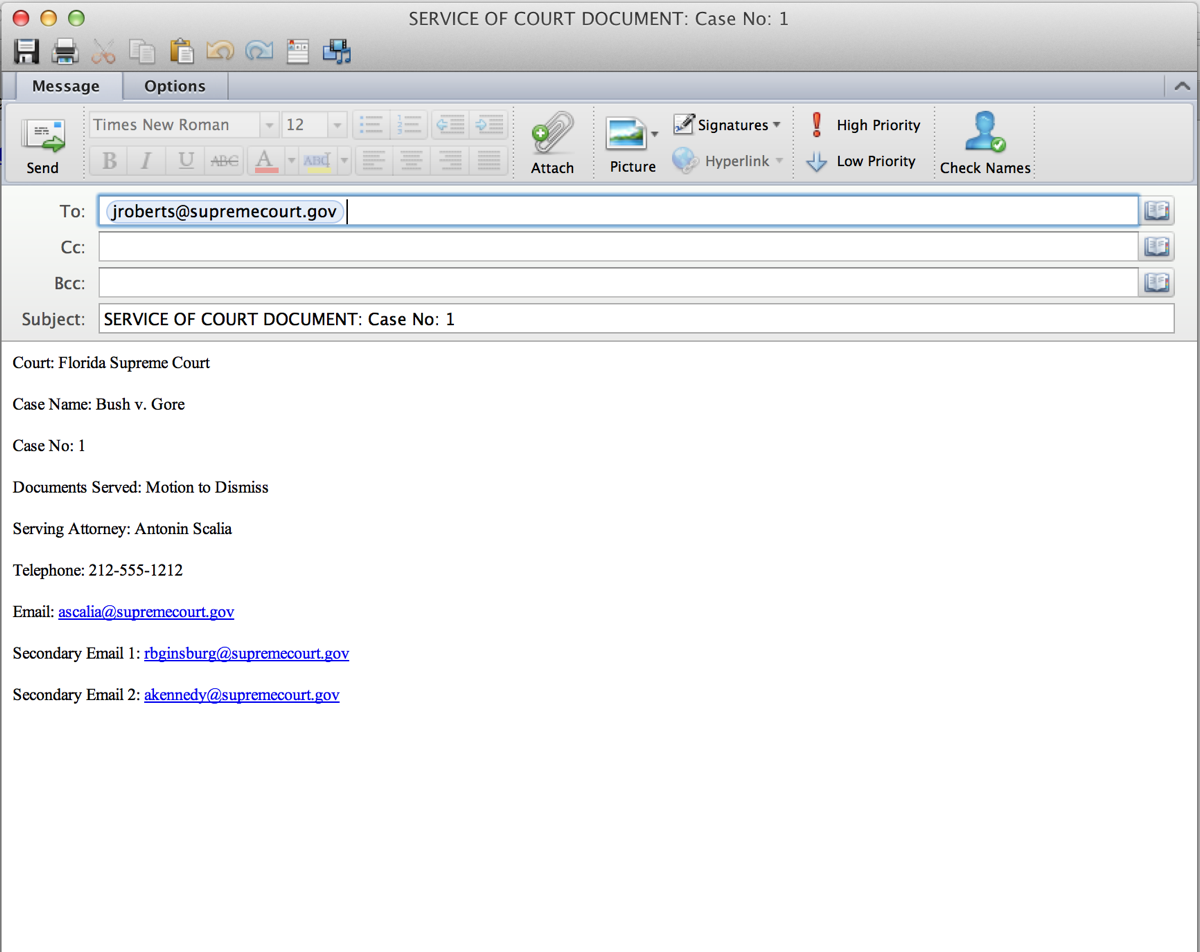
Last month, the Florida Supreme Court issued an opinion requiring email service of all filings in all civil cases effective September 1, 2012. The opinion, available HERE, includes specific requirements for the service of all pleadings and filings and what must be included in the email. Generally, service of documents is now governed by Florida Rule of Judicial Administration Rule 2.516. The subject of the email must contain certain words in all capital letters; the attached filed cannot be over 5mb; and the body of the e-mail is required to contain specific information.

[Update: I have not removed the post below but the domain is no longer active.]

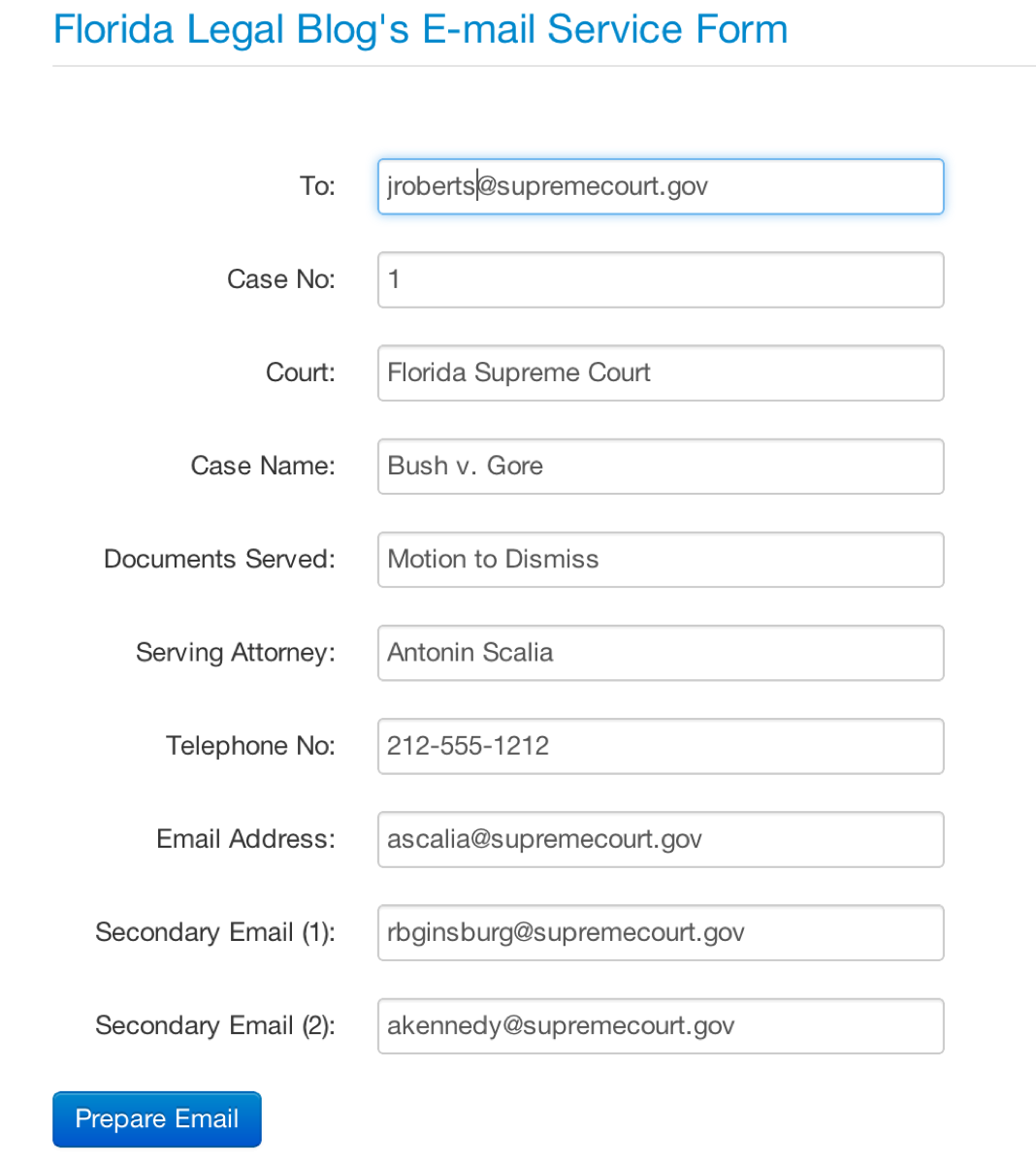
To try and make it a bit easier, with the guidance of a friend, I created a simple website for users to insert information which will open up a new email in the preferred email editor (Outlook, etc.) including the required subject and text. If you go to www.eserve.cc you will see the first page copied below. It is not an extremely difficult process but look below for an explanation of the two step process.
The first page asks for the information below (the email addresses are created by me as an example---hopefully not real):
E-Mail Service Form
The second page simply asks you to click the "Open Email" prompt shown below:
Open Email
Finally, an email that look something like the image below will open in your preferred email editor:
Email for Service

Don't forget to attach the file you are serving….

Thursday, June 28, 2012

Supreme Court's Health Care Opinion & "Who Joined What"

The opinion is below. If you are reading the opinion, here is a guide:

  • 1-6: Syllabus;
  • 7-21: Chief Justice Roberts joined by Justice Ginsburg, Justice Breyer, Justice Sotomayor, and Justice Kagan  (labeled pages 1-15 in the opinion);
  • 22-38: Chief Justice Roberts alone (labeled pages 16-32 in the opinion);

  • 39-50: Chief Justice Roberts joined by Justice Ginsburg, Justice Breyer, Justice Sotomayor, and Justice Kagan  (labeled pages 33-44 in the opinion);
  • 50-51: Chief Justice Roberts alone (labeled pages 44-45 in the opinion);
  • 51-65: Chief Justice Roberts joined by Justice Breyer and Justice Kagan (labeled pages 45-59 in the opinion);

  • 66-103: Justice Ginsburg joined by Justice Breyer, Justice Kagan, and Justice Sotomayor;
  • 103-126: Justice Ginsburg joined by Justice Sotomayor;
  • 127-191: Justice Scalia, Justice Kennedy, Justice Thomas, and Justice Alito; and
  • 191-192: Justice Thomas dissenting.

All of the page numbers refer to the page number in the .pdf and the red page numbers are clearly added by me.
HCA Opinion 11-393c3a2

Wednesday, June 27, 2012

Party Can Reserve Right To Sue Co-Tortfeasors In Release

In Vanalstine v. Palms West Hospital, L.P. (4D10-4850), the trial court entered judgment in favor of the defendants because it concluded language in the plaintiff's release of other persons waived the right to recover from the remaining defendants. The Fourth District disagreed and reversed the judgment because the release "'expressly reserved' the right to pursue causes of action against the medical providers for the damages resulting from their negligence when they settled with the pharmacy and pharmacist.

Friday, June 22, 2012

Fifth District Explains (Again) What Is Needed To Obtain Foreclosure Judgment

In Richards v. HSBC Bank USA as Trustee for PHH 2007 (5D10-3895), the Fifth District reversed a foreclosure judgment and succinctly stated what is needed to prevail in a mortgage foreclosure action. The court stated:

The proper party with standing to foreclose a note and mortgage is the holder of the note and mortgage or the holder’s representative. See Gee v. U.S. Bank Nat’l Ass’n, 72 So. 3d 211, 213 (Fla. 5th DCA 2011). Thus, the party seeking foreclosure must present evidence that it holds the note and mortgage in question in order to proceed with its foreclosure action. Id. A plaintiff must tender the original promissory note to the trial court or seek to reestablish the note under section 673.3091, Florida Statutes (2010). Id. If the note does not name the plaintiff as the payee, the note must bear an endorsement in favor of the plaintiff or a blank endorsement. Id. Alternatively, the plaintiff may submit evidence of an assignment from the payee to the plaintiff or an affidavit of ownership to prove its status as a holder of the note. Id.

In this case, the note was specifically indorsed to an entity other than HSBC and the relationship between that entity and HSBC was not explained. Therefore, summary judgment was not proper.