AFTER THE ENACTMENT OF SECTION 768.28, FLORIDA STATUTES, AND THE ADOPTION OF FLORIDA SENATE RULE 4.81(6), IS IT CONSTITUTIONALLY PERMISSIBLE FOR THE FLORIDA LEGISLATURE TO LIMIT THE AMOUNT OF ATTORNEYS’ FEES PAID FROM A GUARDIANSHIP TRUST ESTABLISHED BY A LEGISLATIVE CLAIMS BILL?All three members of the panel concurred in the certification order.
Wednesday, September 16, 2015
Question As To Whether Legislature Can Limit Attorneys Fees in Claims Bill Sent To Florida Supreme Court
Wednesday, April 29, 2015
U.S. Supreme Court Upholds Florida Ban on Judges Soliciting Campaign Contributions
Thursday, March 19, 2015
Florida Supreme Court: U.S. Supreme Court's 2012 Ban On Life Sentences To Juveniles Applies Retroactively
The issue in this case is whether the United States Supreme Court’s decision in Miller v. Alabama, 132 S. Ct. 2455, 2469 (2012)—which “forbids a sentencing scheme that mandates life in prison without possibility of parole for juvenile offenders”—applies to juvenile offenders whose convictions and sentences were already final at the time Miller was decided.
we conclude that the rule set forth in Miller constitutes a 'development of fundamental significance' and therefore must be given retroactive effect....Accordingly, we answer the certified question in the affirmative and hold that the Supreme Court’s decision in Miller applies retroactively to juvenile offenders whose convictions and sentences were final at the time Miller was decided. Under Florida Rule of Criminal Procedure 3.850(b)(2), any affected juvenile offender shall have two years from the time the mandate issues in this case to file a motion for postconviction relief in the trial court seeking to correct his or her sentence pursuant to Miller.
Based on our decision in Horsley v. State, No. SC13-1938, slip op. at 3 (Fla. Mar. 19, 2015), we conclude that the appropriate remedy for any juvenile offender whose sentence is now unconstitutional under Miller is a resentencing pursuant to the framework established in legislation enacted by the Florida Legislature in 2014. See ch. 2014-220, Laws of Fla.
Thursday, October 30, 2014
Florida Supreme Court Removes County Court Judge From Bench
The charges comprised five categories: I. use of judicial office to promote a private business, Gaza Road Ministries, in which Judge Hawkins was a speaker and a writer, having written and published a book titled “Old Stories, New Insights” based on biblical stories; II. failure to respect and comply with the law; III. failure to act in a manner promoting public confidence in the judiciary; IV. failure to devote full attention to her judicial office; and V. lack of candor with the Judicial Qualifications Commission (the Commission).
For the reasons we explain, based on the violations found by the Hearing Panel which were supported by clear and convincing evidence, we conclude that removal from the bench is the only appropriate sanction in this case.
***
For the reasons set forth herein, we find, based on clear and convincing evidence, that Judge Judith W. Hawkins violated Canons 1, 2A, and 5D of the Code of Judicial Conduct, and that those violations cumulatively warrant the most severe sanction that we impose today. Accordingly, we hereby remove Leon County Judge Judith W. Hawkins from the office of county judge, effective when this decision becomes final. It is our hope that this decision will serve as a reminder to judges of their continuing obligation to personally observe the high standards of conduct mandated by the Code of Judicial Conduct, and to conduct themselves in all things in a manner that will demonstrate candor and preserve the integrity and independence of the judiciary.
Thursday, April 17, 2014
Florida Supreme Court: Pregnancy Discrimination Covered by Florida Civil Rights Act
Thursday, March 6, 2014
Florida Supreme Court: Unauthorized Immigrants Are Ineligible For Admission To the Florida Bar
Indeed, in many respects, Applicant’s life in the United States parallels my own. He and I were brought to this great nation as young children by our hardworking immigrant parents. We both learned to read, write, and speak the English language within a short period of time. We excelled scholastically and graduated from college and law school—Applicant from Florida State University and I from the University of Florida. Both of us were driven by the opportunities this great nation offered to realize the American dream. Sadly, however, here the similarities end and the perceptions of our accomplishments begin. When I arrived in the United States from Cuba in 1963, soon after the Cuban Missile Crisis—the height of the Cold War—my parents and I were perceived as defectors from a tyrannical communist regime. Thus, we were received with open arms, our arrival celebrated, and my path to citizenship and the legal profession unimpeded by public policy decisions. Applicant, however, who is perceived to be a defector from poverty, is viewed negatively because his family sought an opportunity for economic prosperity. It is this distinction of perception, a distinction that I cannot justify regarding admission to The Florida Bar, that is at the root of Applicant’s situation. Applicant is so near to realizing his goals yet so agonizingly far because, regrettably, unlike the California Legislature, the Florida Legislature has not exercised its considerable authority on this important question. Thus, only reluctantly do I concur with the majority decision.
Thursday, October 31, 2013
Florida Rules of Procedure Regarding Recall of Mandate Amended
(a) Issuance and Recall of Mandate. Unless otherwise ordered by the court or provided by these rules, the clerk shall issue such mandate or process as may be directed by the court after expiration of 15 days from the date of an order or decision. A copy thereof, or notice of its issuance, shall be served on all parties. The court may direct the clerk to recall the mandate, but not more than 120 days after its issuance.
(5) Issuance and Recall of Mandate; Recordation and Notification. The clerk shall issue such mandates or process as may be directed by the court. If, within 120 days after a mandate has been issued, the court directs that a mandate be recalled, then the clerk shall recall the mandate. Upon the issuance or recall of any mandate, the clerk shall record the issuance or recall in a book or equivalent electronic record kept for that purpose, in which the date of issuance or date of recall and the manner of transmittal of the process shall be noted. In proceedings in which no mandate is issued, upon final adjudication of the pending cause the clerk shall transmit to the party affected thereby a copy of the court’s order or judgment. The clerk shall notify the attorneys of record of the issuance of any mandate, the recall of any mandate, or the rendition of any final judgment. The clerk shall furnish without charge to all attorneys of record in any cause a copy of any order or written opinion rendered in such action.
(4) Issuance and Recall of Mandate; Recordation and Notification. The clerk shall issue such mandates or process as may be directed by the court. If, within 120 days after a mandate has been issued, the court directs that a mandate be recalled, then the clerk shall recall the mandate. If the court directs that a mandate record shall be maintained, then upon the issuance or recall of any mandate the clerk shall record the issuance or recall in a book or equivalent electronic record kept for that purpose, in which shall be noted the date of issuance or the date of recall and the manner of transmittal of the process. In proceedings in which no mandate is issued, upon final adjudication of the pending cause the clerk shall transmit to the party affected thereby a copy of the court’s order or judgment. The clerk shall notify the attorneys of record of the issuance of any mandate, the recall of any mandate, or the rendition of any final judgment. The clerk shall furnish without charge to all attorneys of record in any cause a copy of any order or written opinion rendered in such action.
Tuesday, June 25, 2013
Supreme Court Reverses Florida Supreme Court in Takings Case
In Koontz v. St. Johns River Water Management District, the United States Supreme Court revered THIS Florida Supreme Court decision. In conclusion, the Supreme Court stated:
We hold that the government’s demand for property from a land-use permit applicant must satisfy the requirements of Nollan and Dolan even when the government denies the permit and even when its demand is for money. The Court expresses no view on the merits of petitioner’s claim that respondent’s actions here failed to comply with the principles set forth in this opinion and those two cases. The Florida Supreme Court’s judgment is reversed, and this case is remanded for further proceedings not inconsistent with this opinion.
From the opinion, "ALITO, J., delivered the opinion of the Court, in which ROBERTS, C. J., and SCALIA, KENNEDY, and THOMAS, JJ., joined. KAGAN, J., filed a dissenting opinion, in which GINSBURG, BREYER, and SOTOMAYOR, JJ., joined."
A complete listing of the opinions below, briefs, and timeline is available from the SCOTUSblog.
Thursday, June 6, 2013
Florida Supreme Court Adopts New Rules On Professionalism For Lawyers
The Court noted the importance of professionalism and that "[s]urveys of both lawyers and judges continue to consistently reflect that professionalism is one of the most significant adverse problems that negatively impacts the practice of law in Florida today."
The Court agreed with the Professionalism Committee that additional measures need to be taken and stated that "While we continue our educational the Professionalism Commission concluded that further integrated, affirmative, practical and active measures are now needed. We agree."
The Court did not, however, "attempt to create an entirely new code of 'professional' or 'unprofessional' conduct " and agreed it should not "at this time, attempt to codify an entirely new 'Code of Professionalism.'” Using the following existing rules and guidelines, the Court created one integrated place to look for professionalism rules and guidance: "(1) the Oath of Admission to The Florida Bar; (2) The Florida Bar Creed of Professionalism; (3) The Florida Bar Ideals and Goals of Professionalism; (4) The Rules Regulating The Florida Bar; and (5) the decisions of the Florida Supreme Court."
Further "The Chief Judge of every circuit shall create a Local Professionalism Panel to receive and resolve professionalism complaints informally if possible. In the discretion of the Chief Judge, the Circuit Committee on Professionalism may be designated as the Local Professionalism Panel. The Chief Judge of each circuit is responsible for activating the respective committees."
The Rules adopted by the Florida Supreme Court are found at Exhibit "A" to the opinion below.
Thursday, April 11, 2013
Florida Supreme Court Clarifies You Do Not Get Five Extra Days When Responding To A Proposal For Settlement
Florida Supreme Court Reverses Decision That Found Class Action Waivers Unconscionable
Applying the rationale of Concepcion to the facts set forth by the Fourth District in McKenzie, we conclude that the FAA preempts invalidating the class action waiver in this case on the basis of it being void as against public policy. Accordingly, we quash the Fourth District’s decision below. We decline to answer the certified question because it is moot in light of Concepcion. In other words, even if the Fourth District is correct that the class action waiver in this case is void under state public policy, this Court is without authority to invalidate the class action waiver on that basis because federal law and the authoritative decision of the United States Supreme Court in Concepcion preclude us from doing so.Justice Pariente wrote the opinion for the court. Justice Quince, Justice Canady, Justice Labarga, and Justice Perry concurred. Chief Justice Polston and Justice Lewis concurred in result only.
The Florida Supreme Court's opinion can be viewed HERE. The Fourth District's opinion, that is now quashed, can be viewed HERE.
Thursday, March 7, 2013
Florida Supreme Court: Economic Loss Rule Abolished Outside Of Products Liability Cases
Having reviewed the origin and original purpose of the economic loss rule, and what has been described as the unprincipled extension of the rule, we now take this final step and hold that the economic loss rule applies only in the products liability context. We thus recede from our prior rulings to the extent that they have applied the economic loss rule to cases other than products liability. The Court will depart from precedent as it does here “when such departure is ‘necessary to vindicate other principles of law or to remedy continued injustice.’ ” Allstate Indem. Co. v. Ruiz, 899 So. 2d 1121, 1131 (Fla. 2005) (quoting Haag v. State, 591 So. 2d 614, 618 (Fla. 1992)). Stare decisis will also yield when an established rule has proven unacceptable or unworkable in practice. See Westgate Miami Beach, Ltd. v. Newport Operating Corp., 55 So. 3d 576, 574 (Fla. 2010). Our experience with the economic loss rule over time, which led to the creation of the exceptions to the rule, now demonstrates that expansion of the rule beyond its origins was unwise and unworkable in practice. Thus, today we return the economic loss rule to its origin in products liability.
CONCLUSIONBecause we now limit the application of the economic loss rule to cases involving products liability, it is not necessary for us to decide whether the economic loss rule exception for professionals applies to insurance brokers. Based on the foregoing, we answer the rephrased certified question in the negative and hold that the application of the economic loss rule is limited to products liability cases. Having answered the rephrased certified question, we return this case to the Eleventh Circuit Court of Appeals.
Wednesday, December 26, 2012
Florida Supreme Court: Certification of Need for Additional Judges
Wednesday, October 10, 2012
Issue Relating To Collection Of Judgment Against The State Certified To Florida Supreme Court
Are property owners who have recovered final judgments against the State of Florida in inverse condemnation proceedings constitutionally entitled to invoke the remedies provided in section 74.091, Florida Statutes, without first petitioning the Legislature to appropriate such funds pursuant to section 11.066, Florida Statutes?The court's opinion in the case, released on July 25, 2012, can be viewed HERE. In the July 25th opinion, the court held: "We reverse that portion of the Palm Beach County order allowing execution against the Department and remand to the circuit courts for further proceedings consistent with this opinion. We also reverse that portion of the Broward County order holding that section 11.066(3) was constitutional as applied, because the issue was not yet ripe."
Tuesday, September 25, 2012
11th Circuit Sends Bad Faith Case Back To District Court After Certified Questions Answered
Accordingly, based on the Florida Supreme Court’s answers to our certified questions, attached hereto as an appendix, we affirm in part and reverse in part the district court’s judgment. We affirm the district court’s judgment of dismissal of Chalfonte’s claim under Section 627.701(4)(a) of the Florida Statutes, because an insured cannot bring a claim against an insurer for failure to comply with the language and type-size requirements established under that statutory provision, and we instruct the district court on remand to disallow any evidence of the policy’s failure to comply with these requirements. We reverse the district court’s order denying QBE a new trial and instruct the court on remand to bifurcate the contract claim from the bad faith claim and to apply the deductible to any judgment Chalfonte may obtain on retrial.The Chalfonte case was previously discussed on this blog HERE and HERE.
Sunday, July 22, 2012
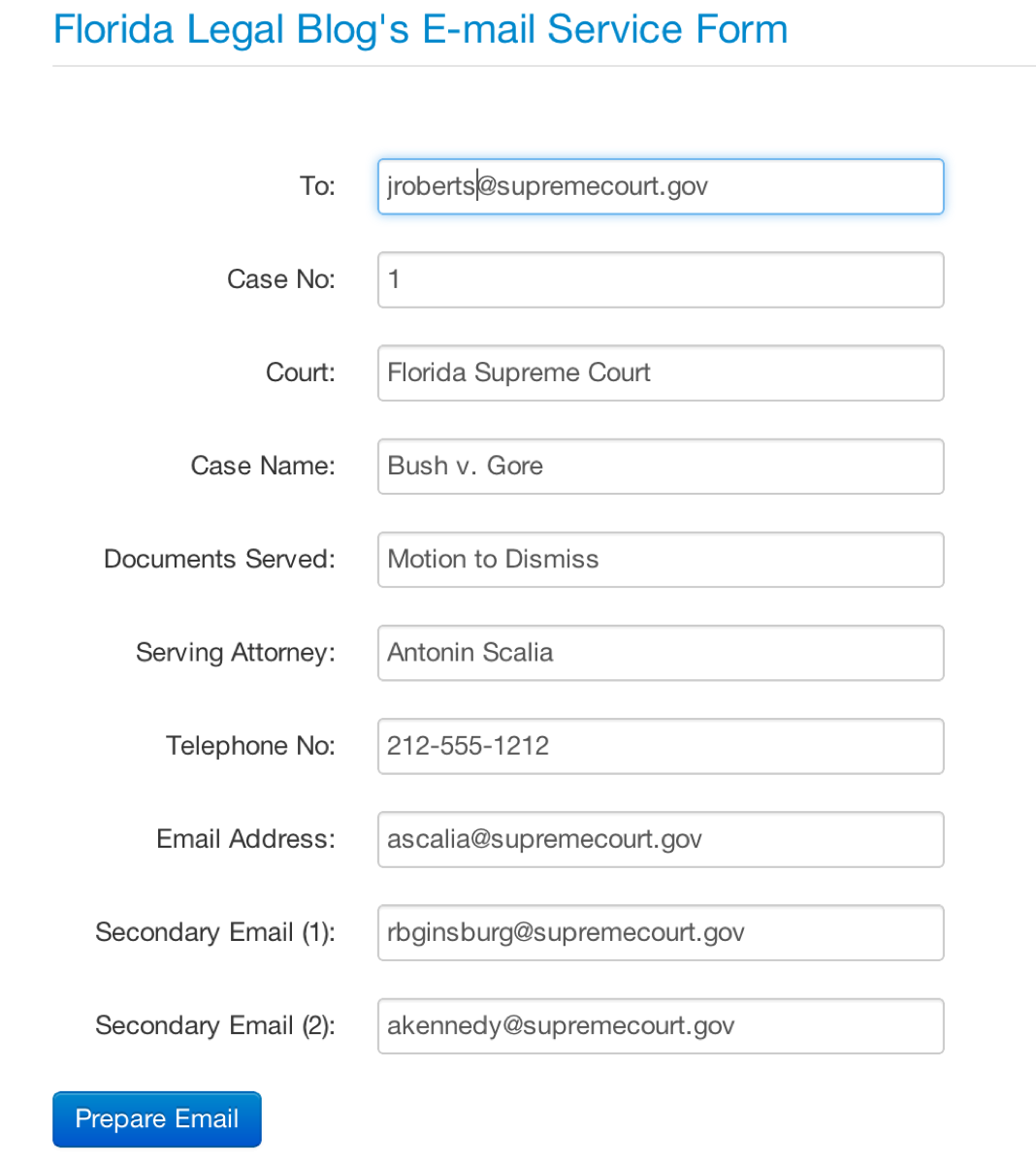
Mandatory E-Mail Service In All Florida Civil Cases & eserve.cc
The second page simply asks you to click the "Open Email" prompt shown below:
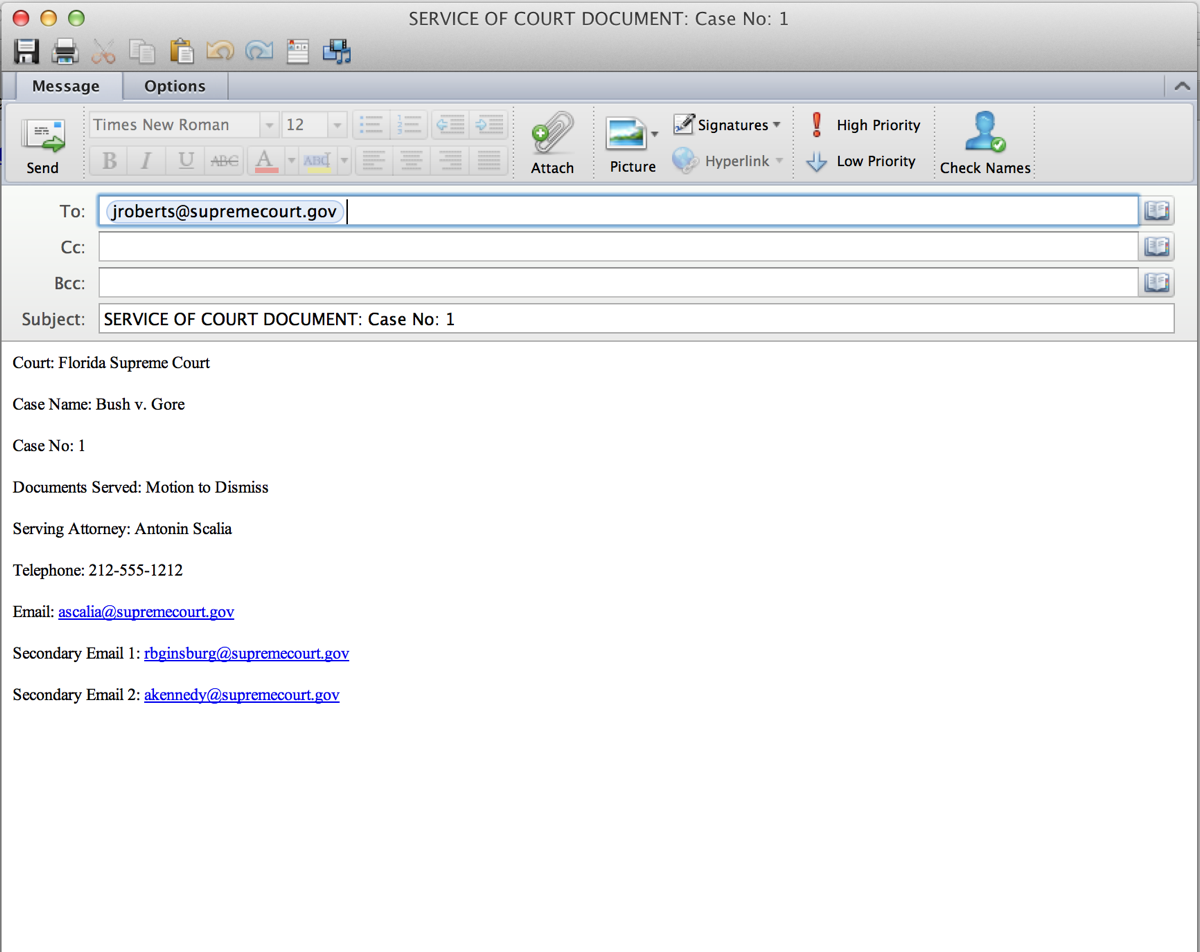
Finally, an email that look something like the image below will open in your preferred email editor:
Don't forget to attach the file you are serving….
Friday, March 16, 2012
Florida Supreme Court Recedes From "Joint Residency Rule" In Venue Disputes
Willie and Brenda Brown filed a complaint in Broward County, Florida, against Kim Nagelhout, Helena Chemical Co., Inc., and CSX Transportation, Inc., alleging multiple causes of action arising from a collision between a truck owned by Helena Chemical and operated by Nagelhout and a train operated by CSX, on which Willie Brown was riding. The collision occurred in Pasco County, Florida.....Relying on Enfinger, the trial court concluded that because Nagelhout and Helena Chemical both reside in Pasco County, Broward County was not a proper venue in which to litigate the Browns' complaint.
Under this statutory scheme, the plaintiff may select a venue within which to litigate a cause of action based on the residency of the defendants. In the instant case, defendant Nagelhout, an individual, resides in Pasco County. Defendant Helena Chemical, a foreign corporation, has a business residence in Pasco County and a registered agent in Broward County. Defendant CSX has its principal place of business in Duval County, Florida, and its registered agent in Leon County, Florida. While it is not clear from the record whether CSX is a domestic or foreign corporation, the defendants do not claim that CSX has “an office for transaction of its customary business” or “an agent or other representative” in Pasco County. § 47.051, Fla. Stat. Thus, based on the above statutes, the Browns had the option to file suit based on residency in Pasco, Broward, Duval, or Leon counties. In their motion to transfer venue, however, the defendants argued that under Enfinger, venue lay only in Pasco County, where Nagelhout and Helena Chemical share a common county of residence.
Here, the joint residency rule of Enfinger is based on a serious interpretative error, which resulted in imposing a meaning on the statute that is “unsound in principle.”...[therefore] we recede from Enfinger's restriction on a plaintif's right to select a venue based on the defendants' residency. When reviewing a plaintiff's venue selection, the Florida courts should apply the plain language of sections 47.011, 47.021, and 47.051, Florida Statutes. Where there are multiple defendants to an action, a plaintiff may choose as venue any county in which any defendant, without consideration of his or her codefendants, may be considered a resident.
Monday, December 19, 2011
Mandatory Mediation Program In Foreclosure Cases Ended
The program was established as a means for the court system to address the overwhelming number of mortgage foreclosure cases coming into the system. The Court has reviewed the reports on the program and determined it cannot justify continuation of the program. Accordingly, upon issuance of this administrative order, the statewide managed mediation program is terminated.
Circuit chief judges are vested under article V, section 2(d), Florida Constitution, with responsibility for the administrative supervision of their circuits. Section 43.26, Florida Statutes, authorizes circuit chief judges “to do everything necessary to promote the prompt and efficient administration of justice.” These authorities empower the circuit chief judges to adopt or employ any measures permitted by statute or court rule to manage pending and new residential mortgage foreclosure cases, including referral of cases to mediation on a case-by-case basis pursuant to section 44.102, Florida Statues, and Florida Rule of Civil Procedure 1.700(a).
Thursday, December 15, 2011
In re: Certification of Need for Additional Judges
Thursday, December 8, 2011
Florida Supreme Court Rejects Stipulation For Dismissal Of Pino v. Bank of New York
DOES A TRIAL COURT HAVE JURISDICTION AND AUTHORITY UNDER RULE 1.540(b), Fla. R. Civ. P., OR UNDER ITS INHERENT AUTHORITY TO GRANT RELIEF FROM A VOLUNTARY DISMISSAL WHERE THE MOTION ALLEGES A FRAUD ON THE COURT IN THE PROCEEDINGS BUT NO AFFIRMATIVE RELIEF ON BEHALF OF THE PLAINTIFF HAS BEEN OBTAINED FROM THE COURT?
The question certified to us by the Fourth District Court of Appeal in this case transcends the individual parties to this action because it has the potential to impact the mortgage foreclosure crisis throughout this state and is one on which Florida’s trial courts and litigants need guidance. The legal issue also has implications beyond mortgage foreclosure actions. Because we agree with the Fourth District that this issue is indeed one of great public importance and in need of resolution by this Court, we deny the parties’ request to dismiss this proceeding.
Consistent with the rationale undergirding our prior precedent, we conclude that these circumstances fully support this Court’s decision to exercise its discretion to retain jurisdiction over and decide the merits of this important case. To adopt the dissent’s interpretation of rule 9.350(a)—that the act of the parties’ stipulation for dismissal is binding on the Court—would require us to recede from our past decisions recognizing just the opposite. Instead, we adhere to our precedent and, accordingly, exercise our discretion to deny the parties leave to dismiss this review proceeding.
Florida Rule of Appellate Procedure 9.350(a) provides that “[w]hen any cause pending in the court is settled before a decision on the merits, the parties shall immediately notify the court by filing a signed stipulation for dismissal.” The rule does not appear to contemplate that such a stipulation for dismissal is subject to disapproval by the Court. The very designation “stipulation for dismissal”—as opposed to “motion for dismissal”—suggests that the act of the parties is dispositive. The committee note to the rule recognizes that dismissal of the case is the clerk’s ministerial duty: “On the filing of a stipulation of dismissal, the clerk of the court will dismiss the case as to the parties signing the stipulation.”.....
Under the Florida Constitution, this Court does not have the power to reach out and grab cases that we deem worthy of our attention. Nor should we exercise the power to grasp a case which has been brought to the Court but which the parties wish to dismiss before it has ever been considered by the Court on the merits. In doing so, we step beyond the proper role of an appellate court to adjudicate those cases that are properly presented to it by a party seeking review.