Sunday, July 22, 2012

Mandatory E-Mail Service In All Florida Civil Cases & eserve.cc

Last month, the Florida Supreme Court issued an opinion requiring email service of all filings in all civil cases effective September 1, 2012. The opinion, available HERE, includes specific requirements for the service of all pleadings and filings and what must be included in the email. Generally, service of documents is now governed by Florida Rule of Judicial Administration Rule 2.516. The subject of the email must contain certain words in all capital letters; the attached filed cannot be over 5mb; and the body of the e-mail is required to contain specific information.

[Update: I have not removed the post below but the domain is no longer active.]

To try and make it a bit easier, with the guidance of a friend, I created a simple website for users to insert information which will open up a new email in the preferred email editor (Outlook, etc.) including the required subject and text. If you go to www.eserve.cc you will see the first page copied below. It is not an extremely difficult process but look below for an explanation of the two step process.
The first page asks for the information below (the email addresses are created by me as an example---hopefully not real):
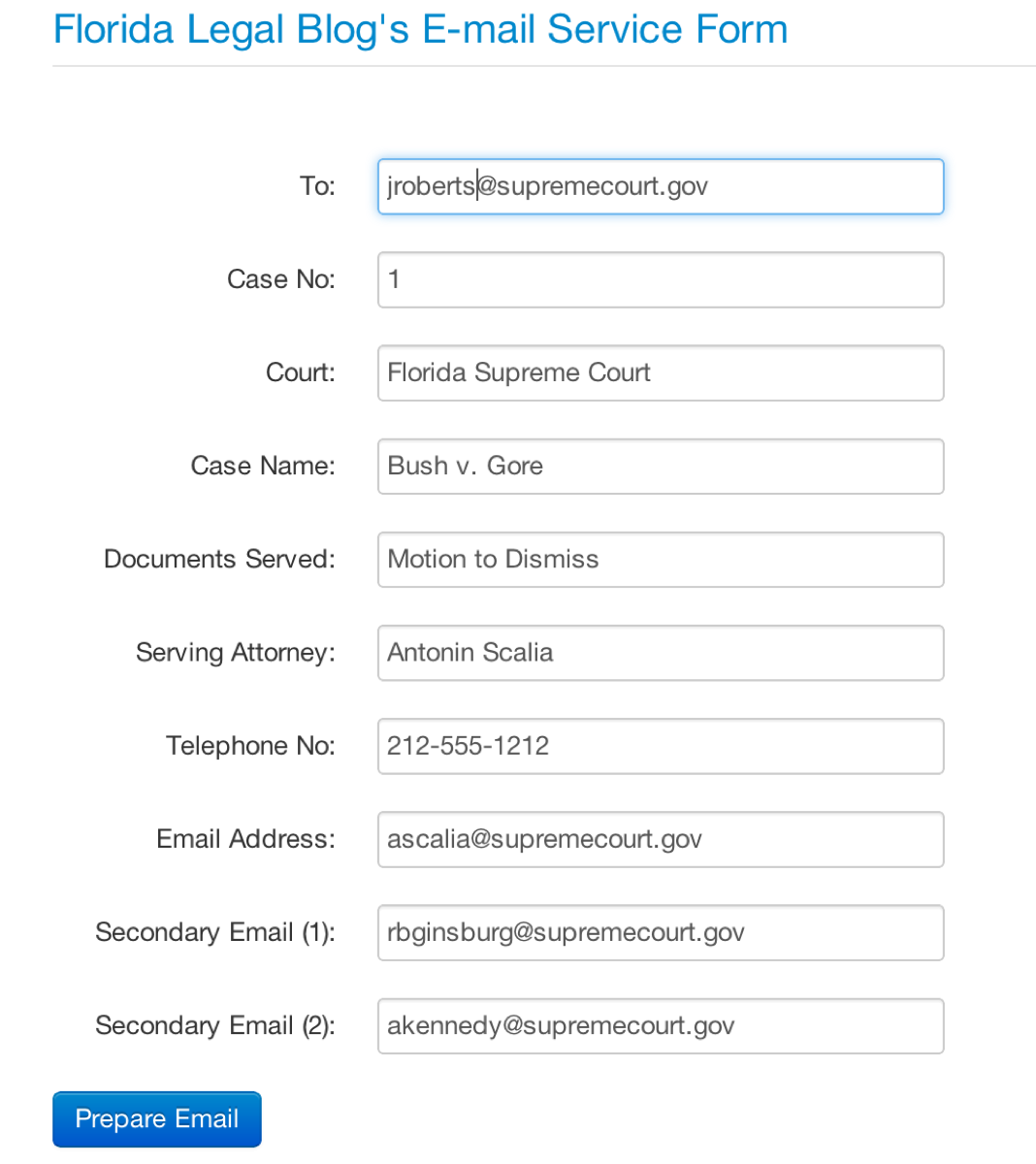
E-Mail Service Form
The second page simply asks you to click the "Open Email" prompt shown below:
Open Email
Finally, an email that look something like the image below will open in your preferred email editor:
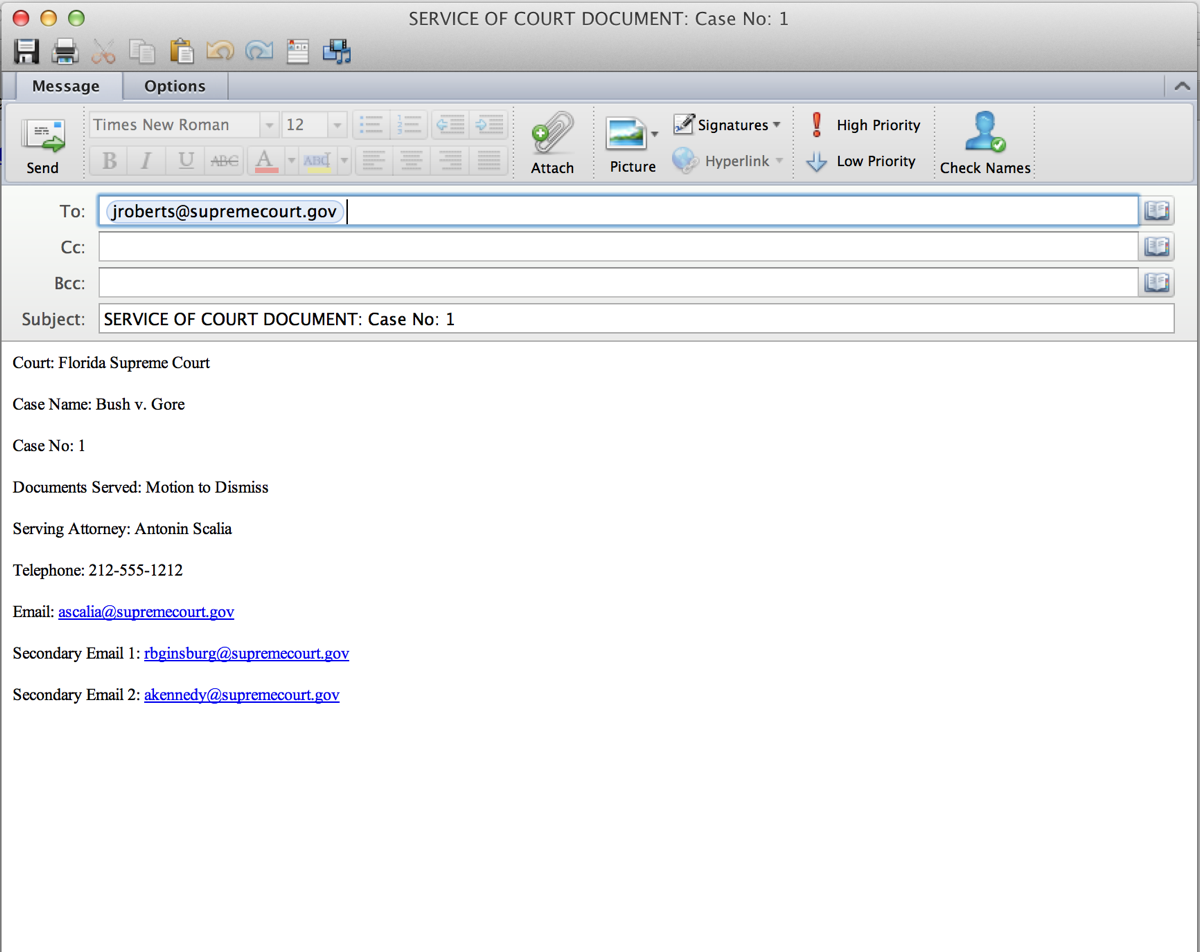
Email for Service

Don't forget to attach the file you are serving….

Thursday, June 28, 2012

Supreme Court's Health Care Opinion & "Who Joined What"

The opinion is below. If you are reading the opinion, here is a guide:

  • 1-6: Syllabus;
  • 7-21: Chief Justice Roberts joined by Justice Ginsburg, Justice Breyer, Justice Sotomayor, and Justice Kagan  (labeled pages 1-15 in the opinion);
  • 22-38: Chief Justice Roberts alone (labeled pages 16-32 in the opinion);

  • 39-50: Chief Justice Roberts joined by Justice Ginsburg, Justice Breyer, Justice Sotomayor, and Justice Kagan  (labeled pages 33-44 in the opinion);
  • 50-51: Chief Justice Roberts alone (labeled pages 44-45 in the opinion);
  • 51-65: Chief Justice Roberts joined by Justice Breyer and Justice Kagan (labeled pages 45-59 in the opinion);

  • 66-103: Justice Ginsburg joined by Justice Breyer, Justice Kagan, and Justice Sotomayor;
  • 103-126: Justice Ginsburg joined by Justice Sotomayor;
  • 127-191: Justice Scalia, Justice Kennedy, Justice Thomas, and Justice Alito; and
  • 191-192: Justice Thomas dissenting.

All of the page numbers refer to the page number in the .pdf and the red page numbers are clearly added by me.
HCA Opinion 11-393c3a2

Wednesday, June 27, 2012

Party Can Reserve Right To Sue Co-Tortfeasors In Release

In Vanalstine v. Palms West Hospital, L.P. (4D10-4850), the trial court entered judgment in favor of the defendants because it concluded language in the plaintiff's release of other persons waived the right to recover from the remaining defendants. The Fourth District disagreed and reversed the judgment because the release "'expressly reserved' the right to pursue causes of action against the medical providers for the damages resulting from their negligence when they settled with the pharmacy and pharmacist.

Friday, June 22, 2012

Fifth District Explains (Again) What Is Needed To Obtain Foreclosure Judgment

In Richards v. HSBC Bank USA as Trustee for PHH 2007 (5D10-3895), the Fifth District reversed a foreclosure judgment and succinctly stated what is needed to prevail in a mortgage foreclosure action. The court stated:

The proper party with standing to foreclose a note and mortgage is the holder of the note and mortgage or the holder’s representative. See Gee v. U.S. Bank Nat’l Ass’n, 72 So. 3d 211, 213 (Fla. 5th DCA 2011). Thus, the party seeking foreclosure must present evidence that it holds the note and mortgage in question in order to proceed with its foreclosure action. Id. A plaintiff must tender the original promissory note to the trial court or seek to reestablish the note under section 673.3091, Florida Statutes (2010). Id. If the note does not name the plaintiff as the payee, the note must bear an endorsement in favor of the plaintiff or a blank endorsement. Id. Alternatively, the plaintiff may submit evidence of an assignment from the payee to the plaintiff or an affidavit of ownership to prove its status as a holder of the note. Id.

In this case, the note was specifically indorsed to an entity other than HSBC and the relationship between that entity and HSBC was not explained. Therefore, summary judgment was not proper.

Wednesday, May 9, 2012

Testimony Of Witness That Dies Before Completion Of Deposition Is Admissible, Regardless Of Whether Cross Examination Occurred

In The Bank of Montreal v. Estate of Antoine (4D10-760), Antoine embezzled more than $13 million in bank funds. After he was arrested, pled guilty, and sentenced to serve his prison sentence in federal prison, the bank sued Antoine and his wife. As part of the suit, the bank sought to place an equitable lien on a residence allegedly purchased with the stolen funds. The bank took Antoine's deposition and Antoine admitted that the residence was purchased with stolen funds. Unfortunately, during the deposition Antoine experienced chest pains which prevented his co-defendant wife from cross examining him. A few days after the deposition was postponed, Antoine died.

During trial, Antoine's wife sought to exclude his testimony because she was not able to question him. The trial court agreed and excluded the deposition from trial. The Fourth District analyzed analogous caselaw from around the country and held that the partial deposition was improperly excluded. Deposition of an unavailable witness is generally not excluded if the objecting party had a chance to cross examine the witness at the deposition. See Fla. Stat. § 90.804(2)(a). Antoine's wife did not have the opportunity to question Antoine, however, "Florida Rule of Civil Procedure 1.330(a) provides that:

[a]t the trial...any part or all of a deposition may be used against any party who was present or represented at the taking of the deposition or who had reasonable notice of it so far as admissible under the rules of evidence applied as though the witness were then present and testifying in accordance with any of the following provisions:....(3) The deposition of a witness, whether or not a party, may be used by any party for any purpose if the court finds: (A) that the witness is dead . .. .

[emphasis supplied]. "Hearsay which is inadmissible because it does not satisfy the provisions of the former testimony rule will still be admissible if it satisfies the provisions of rule 1.330."

The court then discussed the applicable authorities from around the country which "establish that it is appropriate for us to consider the value that the wife’s cross-examination of Antoine would have provided to her defense." In this case, the court determined the cross examination would not have elicited anything of importance. Therefore, the deposition should have been admitted.

Monday, April 30, 2012

Note Merges Into Judgment & "cause’s independent existence terminates"

In Weston Orlando Park, Inc. v. Fairwinds Credit Union (5D11-2260), the Fifth District affirmed the trial Court's judgment with one exception. That exception is copied below:

The trial court could not reserve jurisdiction on Fairwinds’s claims for breach ofthe promissory notes, separate from the claims for foreclosure, because the debtrepresented by the notes had merged into the final judgment. The doctrine of mergerprovides that when a valid and final judgment is rendered in favor of a plaintiff, theoriginal debt or cause of action upon which an adjudication is predicated merges intothe final judgment, and, consequently, the cause’s independent existence terminates.


Sunday, April 29, 2012

Appeal Of Judgment Dismissed For Failure To Comply With Trial Courts Post Judgment Orders

In Daniels v. JPMorgan Chase Bank, et al, (3D11-1237), the Third District dismissed an appeal of a final judgment due to the appellants failure to comply with post judgment orders entered by the trial court. The court stated "A party in contempt of the trial court cannotseek to invoke the authority of this Court." The court did stay the dismissal for twenty days to allow the appellant to correct the failure to comply with the trial courts orders.

What A Court Must Consider To Sanction A Party

In Martin v. Maroone Chevrolet of Delray Beach (4D10-5006), the Fourth District again stated the test a court must follow to strike a pleading. The court stated:
Before a court may strike a party’s pleadings as a sanction, the courtmust consider the following factors:
1) whether the attorney’s disobedience was willful,deliberate, or contumacious, rather than an act of neglect orinexperience; 2) whether the attorney has been previouslysanctioned; 3) whether the client was personally involved inthe act of disobedience; 4) whether the delay prejudiced theopposing party through undue expense, loss of evidence, orin some other fashion; 5) whether the attorney offered reasonable justification for noncompliance; and 6) whetherthe delay created significant problems of judicial administration.
The court must also consider whether a lesser sanction would be a“viable alternative.” Id. Whether the litigant was involved in themisconduct is a factor to be weighed in the Kozel analysis, but does notweigh more heavily than the other factors. See Ham v. Dunmire, 891 So.2d 492, 497 (Fla. 2004). “The Kozel criteria with an emphasis onwhether prejudice has occurred control.” Id. at 502.

Friday, March 16, 2012

Florida Supreme Court Recedes From "Joint Residency Rule" In Venue Disputes

In Brown v. Nagelhout (SC10-868), the Florida Supreme Court receded from its 1957 opinion, Enfinger v. Baxley, 96 So. 2d 538 (Fla. 1957), and abolished "the judicially created joint residency rule" applied in venue challenges. The court described the facts as follows:
Willie and Brenda Brown filed a complaint in Broward County, Florida, against Kim Nagelhout, Helena Chemical Co., Inc., and CSX Transportation, Inc., alleging multiple causes of action arising from a collision between a truck owned by Helena Chemical and operated by Nagelhout and a train operated by CSX, on which Willie Brown was riding. The collision occurred in Pasco County, Florida.....Relying on Enfinger, the trial court concluded that because Nagelhout and Helena Chemical both reside in Pasco County, Broward County was not a proper venue in which to litigate the Browns' complaint.
With regard to the legal issues, the court first noted that "[t]he determination of venue in Florida is governed by a series of statutory provisions set forth in chapter 47, Florida Statutes (2011)." After discussing the relevant statutory language, the court stated "[f]inally, section 47.021, Florida Statutes (2011), provides that '[a]ctions against two or more defendants residing in different counties may be brought in any county in which any defendant resides.'”
Under this statutory scheme, the plaintiff may select a venue within which to litigate a cause of action based on the residency of the defendants. In the instant case, defendant Nagelhout, an individual, resides in Pasco County. Defendant Helena Chemical, a foreign corporation, has a business residence in Pasco County and a registered agent in Broward County. Defendant CSX has its principal place of business in Duval County, Florida, and its registered agent in Leon County, Florida. While it is not clear from the record whether CSX is a domestic or foreign corporation, the defendants do not claim that CSX has “an office for transaction of its customary business” or “an agent or other representative” in Pasco County. § 47.051, Fla. Stat. Thus, based on the above statutes, the Browns had the option to file suit based on residency in Pasco, Broward, Duval, or Leon counties. In their motion to transfer venue, however, the defendants argued that under Enfinger, venue lay only in Pasco County, where Nagelhout and Helena Chemical share a common county of residence.
In conclusion, the court held:
Here, the joint residency rule of Enfinger is based on a serious interpretative error, which resulted in imposing a meaning on the statute that is “unsound in principle.”...[therefore] we recede from Enfinger's restriction on a plaintif's right to select a venue based on the defendants' residency. When reviewing a plaintiff's venue selection, the Florida courts should apply the plain language of sections 47.011, 47.021, and 47.051, Florida Statutes. Where there are multiple defendants to an action, a plaintiff may choose as venue any county in which any defendant, without consideration of his or her codefendants, may be considered a resident.